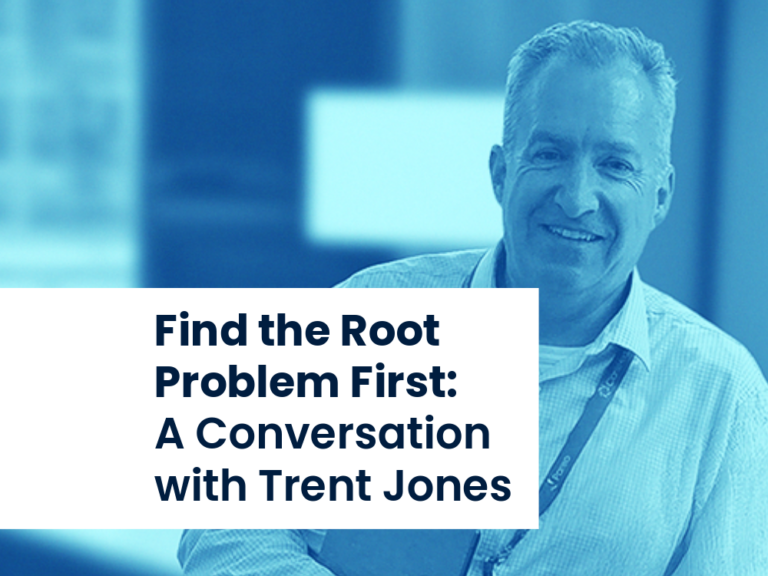
Find the Root Problem First: A Conversation with Trent Jones, Senior Director of Product
Eleven years of turning organizational challenges into product features reveals why the first request is rarely the real problem.
Trent Jones has spent about 11 years turning operational challenges into product features, and he still starts every project by asking what the problem really is.
Every health plan that comes to Pareo® arrives with a payment integrity goal or problem it has already tried to solve. Usually that means a spreadsheet, a custom build or a workaround that has grown for years. The request sounds specific, but the real problem is usually one layer down.
Trent has spent his career finding that layer. He came to product through implementation work on the provider side, moved through revenue cycle and EHR projects, and now works on payer-side solutions at ClarisHealth, where he is in his ninth year.
In this conversation with Director of Community Amanda Bair, he shares:
- How he got into product
- Why product development is an iterative process
- How he thinks about the lines between standards, configurability and customization

Trent Jones
Senior Director of Product
What You Find When You Go One Layer Deeper: Q&A with Trent Jones
Amanda Bair: How did you get into product work, and how far off was the job from what you expected?
Trent Jones: I started on the provider side, in implementation. You work inside constraints someone else set, and you get good at finding ways to solution for your clients with what you have available. What I liked was solving problems. Product let me build the fences instead of working inside them.
The problems on the payer side are different, but the work is fundamentally the same. The first thing a client tells you is usually the surface problem. You have to ask a lot more questions to find the root. It’s detective work. Once you solve it, you see the results, and it’s never perfect to begin with. But you iterate from there.
Implementation also taught me to listen. You show up at a practice not knowing what you’ll find, meet people, help them feel comfortable, and show them how to take what they already do and move it into something new.
AB: When a health plan’s request seems to conflict with what the rest of the client base needs, how do you decide what goes on the roadmap?
TJ: This is harder in payer work because plans have built systems on top of systems. Their existing processes are custom, so when they come to us, they describe their problem as custom work. Our job is to step back, find the root problem and then talk to five or six clients facing a similar issue. We translate those answers into something that solves the problem for everyone. Often, that means configuration. The product is flexible enough for each plan to adapt it, but everyone is solving the same problem.
The biggest risk on the product side is solutioning too early. Everyone has a favorite way to solve something. You have to force yourself to hold off, lay out several approaches and get input from the whole team. It can’t be one person’s idea.
AB: Where does standardization end and client-specific customization begin?
TJ: You never want complete customization. Standards always have to be part of it, especially for data. If you don’t have standards, you can’t have KPIs that make sense as they flow upstream and downstream. If every client’s data is customized, it’s hard to relate it to anything else.
So it’s a mix, and the mix is configurability, not customization. Standards keep the integrity of the data moving the right way. Configuration can get more granular so clients feel like they have something built for them.
Some requests still cross that line. A client might have a niche need that fits the platform, and at that point it becomes a unique build. But before you build it, you have to know how you’ll launch it, how you’ll roll it out, and whether you’ll support it or hand it over to the client.
AB: Tell me about a feature in Pareo® that you shepherded from a rough prototype to something users rely on every day.
TJ: Inventory management is the best example. We started with work queues, and they’re still used today. A work queue is basically a large filter. It buckets audit work so multiple people can pull from the same pool. Then we added inventory assignment capability, where rules route audits to individuals or teams. We’ve been expanding that to more users and trying to combine work queues and inventory into one centralized view. We’re not there yet, but we’re getting closer.
Newer clients have the benefit of seeing – from the beginning of their Pareo experience – how these approaches can work in concert, depending on the goals and context. Inventory management lets managers push the highest-priority, highest-value work first. A work queue lets people choose what to work on during the day. Both have their place.
Variance management is another example. A client had a specific need, and we talked to several other plans about how they handled variances. Based on those discussions, we made that feature uniquely configurable. Plans set their own threshold for small balances, then decide whether to adjust through a transaction or update the audit amount directly. It has been adopted widely, from large plans to smaller ones. We kept iterating across several releases after launch.
AB: What metrics tell you a release worked?
TJ: Usability. We track what gets used, how often, which path people take to get there and what they click along the way. The first question is whether anyone is using it and how many people are.
The right measure depends on the feature. For variance management, the question was whether people could find, decide and act in one place instead of moving between screens.
AB: Which commonly used success metrics do you think are overemphasized or misleading?
TJ: A common problem arises when teams decide what success means after delivery. The target metrics and tracking mechanisms, ideally, should be planned from the start.
You can rush timelines, but you still have to follow the process. Understand the problem, understand how users work, and agree upon the target KPIs. If one user says, “This is what we want you to build,” and you deliver it, then everybody wonders why you missed the mark? I’ll tell you why. You shortcut the process.
AB: You’ve been in product for a long time, more than half of that working on Pareo. What keeps you motivated?
TJ: I love product work. I love hearing problems, trying to solve them and being in a position to be the voice of the users. That’s what has kept me here.
It’s also amazing to me how much opportunity exists for innovation in payment integrity. In so many of these enormous organizations, there are still a lot of spreadsheets passed from person to person. Everyone is being asked for bigger goals with fewer people. Making them more empowered and efficient, so they can make quicker decisions with the data in front of them, is a challenge I enjoy.
Conclusion
Every project starts with a request that describes the surface problem. Trent’s career has been about asking the next question, and then the one after that, until the real problem is clear enough to build against.
Even then, the work doesn’t stop. In enterprise software, the platform is never finished – and that’s the point. What matters is the base you build and how you keep iterating on it. For a health plan evaluating Pareo, that means asking a vendor how it finds the root problem, how it decides between a shared standard and a one-off build, and what it measures after release. Those answers are perhaps even more revealing than a feature list.
Now’s the time for total payment integrity
See the ClarisHealth 360-degree solution for total payment integrity in action.
News + Resources
Category